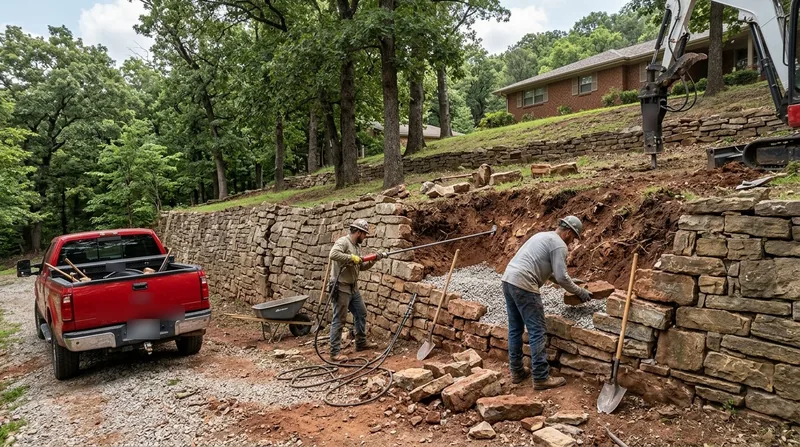




When a retaining wall repair in Tulsa is on your mind, you are usually looking at a wall that has started to lean, bow, crack, or settle. Tulsa sits where the Osage Hills meet the Arkansas River valley, so hillside lots in Gilcrease Hills and south Tulsa around Turkey Mountain put constant pressure on walls built into red expansive clay over shallow shale and sandstone. Freeze-thaw cycles, ice storms, and heavy spring downpours push that clay around, and older native sandstone, fieldstone, poured concrete, CMU, and railroad tie walls take the hit first. We repair leaning, bowed, cracked, and settling walls before they become a collapse. If you are comparing repair against a full rebuild, start with our leaning and collapsed wall repair page and then call (918) 359-8655.
Why Retaining Wall Repair Matters on Tulsa's Clay and Hillsides
Tulsa's red expansive clay swells when it gets wet and shrinks when it dries, and that cycle works a wall back and forth until the footing moves or the face bows. Add shallow shale and sandstone under many lots, plus freeze-thaw and ice storms, and the failure mode that dominates here is clay movement pushing a wall outward, not coastal-style erosion. Walls in Maple Ridge, Brady Heights, Brookside, and Swan Lake often sit on lots graded decades ago, while 1980s to 2000s brick homes in south Tulsa have segmental block walls now showing settlement. Catch it early and repair is a fraction of replacement.
- We correct drainage so water stops saturating the clay behind the wall.
- We install tieback anchors to pull a leaning wall back toward stable soil.
- We rebuild failed sections and reset footing where settlement has opened cracks.
- We replace rotting railroad tie and timber walls that have lost their structural capacity.
- We stabilize slopes above and below walls before movement spreads to a patio or driveway.
Every repair starts with finding the water source and the movement pattern, because patching a crack without fixing the cause just buys you one more season.
Key info: A bowed segmental block wall on a south Tulsa lot near Turkey Mountain is usually clay pushing from behind, not bad block. We check drainage and soil pressure first, then price the anchor or rebuild that actually stops the movement.
For official guidance on when a wall needs a permit or engineered drawings, check the City of Tulsa building permit information at cityoftulsa.org and confirm thresholds with the local building department before work starts.
How We Repair a Failing Wall in Tulsa, Step by Step
We do not guess at a repair from the curb. We walk the wall, check the soil and drainage, and look at what the wall is holding back, whether that is a hillside in Gilcrease Hills, a driveway in Bixby, or a creek-side slope near Joe Creek. Then we choose the least invasive method that solves the actual problem. If the wall is too far gone, we tell you and point you to retaining wall replacement instead of selling a repair that will not hold.
- We inspect the wall face, footing, drainage, and soil conditions on site.
- We identify the failure mode: clay pressure, water, frost movement, or footing settlement.
- We correct drainage with proper backfill, gravel, and outlet piping.
- We install anchors, rebuild sections, or reset footing depending on what the wall needs.
- We restore the surface and confirm water now flows away from the wall.
You get a written scope and a clear price before we start, so there are no surprises mid-job.
Key info: A Jenks homeowner had a block wall bowing toward the patio after spring rains. We found a clogged drain and saturated clay, cleared and rebuilt the drainage, anchored the bowed section, and the wall has stayed put through two freeze-thaw seasons.
Repair Methods We Use on Tulsa Walls
Not every wall fails the same way, so we match the method to the wall type and the soil. Native sandstone and fieldstone walls in older neighborhoods need different handling than poured concrete or segmental block. The table below shows the approaches we use most often in Tulsa and what each one is best at.
| Approach | Description | Best for |
|---|---|---|
| Drainage correction | Clearing, rebuilding, and re-routing water behind the wall | Walls bowing after heavy spring rain |
| Tieback anchors | Anchoring the wall face back into stable soil | Leaning block or concrete walls |
| Partial rebuild | Removing and resetting failed sections and footing | Cracked or settled wall runs |
| Timber and tie replacement | Swapping rotted ties for sound material | Aging railroad tie walls on sloped yards |
| Slope stabilization | Regrading and reinforcing soil above or below the wall | Hillside lots near Turkey Mountain |
We pick the method that fixes the cause, not just the visible crack, so the repair holds through Tulsa's wet springs and dry summers.
Retaining Wall Repair Cost in Tulsa: What to Expect
Most retaining wall repairs in Tulsa start around $1,500 and go up from there depending on the scope. A small drainage fix or a single anchored section sits near that starting point, while a long bowed wall, a partial rebuild, or a hillside job near Turkey Mountain costs more because of access, soil conditions, and the amount of wall that has to come apart. Getting two or three estimates is smart, and it helps you compare scope, not just the bottom line. Our pricing overview breaks down how the numbers move.
- Wall length and height drive how much material and labor the repair takes.
- Access matters on tight hillside lots where equipment cannot reach the wall easily.
- Soil and drainage conditions in red clay often add work behind the wall face.
- Proximity to structures such as a patio, driveway, or foundation raises the care level.
- Wall material (native stone, concrete, block, or timber) affects how the repair is done.
We give you a written scope and price so you can see exactly what the estimate covers before you commit.
What to Look for When Hiring a Retaining Wall Contractor Near Tulsa
Hiring the right contractor near Tulsa comes down to proof, not promises. Ask for a license and insurance certificate, get at least two or three written estimates, and ask for references from jobs similar to yours. Confirm who pulls the permit, since many jurisdictions require one for walls above roughly 4 feet measured from the footing or when the wall supports a surcharge like a driveway. If you are in an HOA, check its rules on wall material and height before work starts. Reach us through our contact page and we will walk you through the process.
- Verify the contractor is fully insured before any work begins.
- Get two or three written estimates and compare the scope line by line.
- Ask for references from Tulsa-area wall repairs similar to yours.
- Confirm the permit responsibility and check HOA requirements early.
- Ask how they will handle drainage and soil, not just the visible crack.
A contractor who explains the cause of the failure and the fix in plain terms is the one worth hiring.
Retaining Wall Repair in Tulsa: Pricing Guide
| Service | Price | Details |
|---|---|---|
| Drainage correction and crack repair | Starting at $1,500 | Includes clearing and rebuilding drainage behind the wall plus sealing visible cracks. |
| Tieback anchor installation | Starting at $2,800 | Anchors a leaning wall back into stable soil, priced by wall length and access. |
| Partial rebuild of failed section | Starting at $4,500 | Removes and resets failed block or concrete, cost rises with height and footing work. |
| Complex or hillside repair | On estimate | Sloped lots near Turkey Mountain need an on-site look at soil, access, and surcharge. |
| Travel | Included | In Tulsa and surrounding areas, no separate call-out or mileage fee. |
| Estimate | Free | Response within 24h at (918) 359-8655, no obligation to book. |
Indicative pricing, the exact cost depends on square footage, finish, and site access. Free personalized estimate within 24h at (918) 359-8655.


