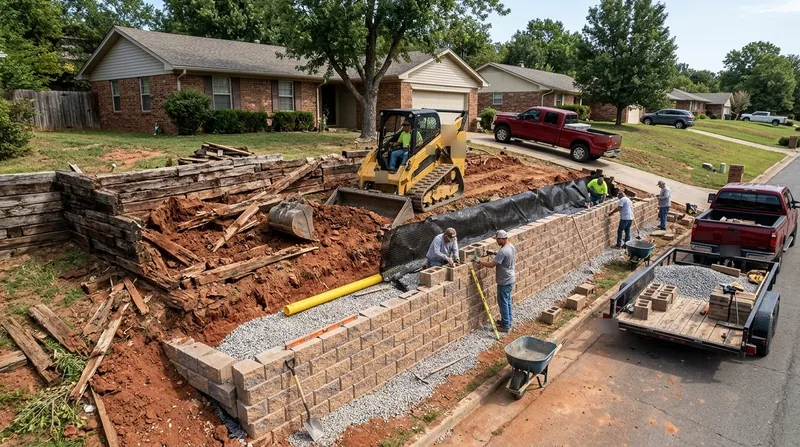




Tulsa sits where the Osage Hills drop into the Arkansas River valley, and that terrain is exactly why retaining wall replacement in Tulsa is a year-round call we answer. Hillside lots in Gilcrease Hills and around Turkey Mountain, the older bungalow blocks of Brookside and Florence Park, and the flatter east side all hold walls that were never built for red expansive clay over shallow shale. Freeze-thaw cycles, ice storms and heavy spring downpours work those walls loose until they lean, bulge or drop a whole section. We tear out the failed wall, haul it off, and rebuild it with modern drainage and materials that match the slope you actually have. If your wall is still standing but moving, start with retaining wall repair before replacement becomes the only option.
Why failed walls keep showing up across Tulsa's hillsides and creek corridors
Most of the walls we replace in Tulsa were built before anyone thought about drainage. Railroad tie walls from the 1970s and 80s are rotting from the inside out. Dry-laid sandstone and fieldstone walls in Maple Ridge and Brady Heights have lost their batter and are pushing out at the base. Poured concrete and CMU walls crack when the clay behind them swells after a wet spring and shrinks in August.
- Red expansive clay traps water against the wall face and adds pressure every wet season.
- Freeze-thaw cycles open joints and shift capstones through January and February.
- Ice storms drop limbs and debris that clog weep holes and outlet pipes.
- Spring downpours overwhelm undersized drains in Joe Creek and Mingo Creek corridors.
- Aging railroad tie and timber walls rot at the soil line and lose their tiebacks.
When you see bulging, leaning or a section that has already dropped, the wall is past patching and replacement is the honest answer.
Key info: A 1980s railroad tie wall on a sloped lot in Broken Arrow failed after one ice storm season because the ties had rotted at the soil line and the original drainage was a single gravel trench with no outlet. We rebuilt it as a segmental block wall with a perforated drain and a daylighted outlet.
For permit thresholds and engineered drawing requirements, verify with the City of Tulsa building department before any wall above roughly 4 feet or any wall carrying a driveway or structure: City of Tulsa.
How we replace a retaining wall in Tulsa, step by step
Replacement is not a patch job. We start by finding out why the old wall failed, because rebuilding the same way on the same soil gets the same result. On most Tulsa lots that means digging back to the footing, checking the native shale or sandstone, and redesigning the drainage before we set the first block.
- We walk the wall, the slope above it and the drainage path below it with you on site.
- We take measurements, check the soil and confirm what the wall is holding back.
- We pull the permit if the wall height or surcharge requires one.
- We demolish the old wall and haul away ties, block, concrete and debris.
- We excavate to the new footing depth and compact the base.
- We install drainage stone, perforated pipe and a daylighted outlet.
- We build the new wall with the right material for the slope and load.
- We backfill in lifts, compact, and restore the grade and any planting above the wall.
Every step is documented so you know what is going behind the wall, not just what you see from the yard.
Key info: On a hillside lot near Turkey Mountain in south Tulsa, we replaced a crumbling dry-laid sandstone wall with a segmental block wall tied into the shale and drained to daylight at the street. The original wall had no drainage at all, which is why it let go after a wet spring.
If your wall is still standing but the drainage is the weak point, see our retaining wall drainage page before you decide on a full rebuild.
Replacement approaches we use on Tulsa walls
The right approach depends on the height, the load behind the wall and the look you want. We match the material to the slope and the house, not to a catalog page.
| Approach | Description | Best for |
|---|---|---|
| Segmental block replacement | Engineered block with geogrid, gravel backfill and a perforated drain. | Hillside lots in Gilcrease Hills, south Tulsa and Broken Arrow. |
| Poured concrete replacement | Reinforced footing and wall poured on site with formed joints. | Tall walls, driveways and structural surcharges. |
| Boulder and natural stone | Native sandstone or fieldstone reset with proper batter and drainage. | Maple Ridge, Brady Heights and older Tulsa neighborhoods. |
| Timber and tie replacement | Rotting railroad tie walls pulled and rebuilt with modern materials. | 1970s and 80s walls in Brookside, Swan Lake and Florence Park. |
| Tiered wall systems | Two or three shorter walls with benches and drainage between. | Steep lots where a single tall wall is not practical. |
We will tell you which approach fits your slope and budget before any material is ordered.
Retaining Wall Replacement Cost in Tulsa: What to Expect
Replacement pricing in Tulsa starts at From $35/sq ft for a basic segmental block wall with standard drainage, and moves up from there. The square footage of the wall face is only part of the number. Access, demolition, haul-away, soil conditions and the load the wall is holding all change the final figure.
- Wall height and total face square footage drive the base price.
- Demolition and haul-away of the old wall add cost, especially concrete and buried tiebacks.
- Tight access in Brookside or Maple Ridge lots means hand work and slower production.
- Expansive clay or shallow shale may require over-excavation and engineered backfill.
- Driveway or structure surcharges require engineering and a stronger wall.
- Drainage outlet distance to daylight affects the drain scope.
Get two or three written estimates on the same scope so you are comparing like for like, not a low bid that skips drainage. Our full pricing overview breaks down what each tier includes.
Retaining Wall Replacement Near Me: How to Choose a Contractor Near Tulsa
Replacement is a structural job, and the contractor you hire matters more than the block brand. Ask for proof of license and insurance, and confirm the policy covers retaining wall work, not just general landscaping. Get at least two or three estimates, and ask each contractor to explain the drainage design, not just the wall face.
- Confirm the company is fully insured and can provide a certificate.
- Ask for references from walls of similar height and soil conditions.
- Check who pulls the permit and whether engineered drawings are required.
- Ask how they handle HOA approval if your neighborhood has one.
- Ask what happens if they hit rock or a buried old footing during excavation.
When you are ready to talk through your wall, reach out through our contact page and we will set up a free on-site estimate.
Retaining Wall Replacement in Tulsa: Pricing Guide
| Service | Price | Details |
|---|---|---|
| Segmental block wall replacement | Starting at $35/sq ft | Includes demolition, haul-away, compacted base, drainage stone and pipe, and block installation on standard access lots. |
| Poured concrete wall replacement | Starting at $55/sq ft | Includes forms, rebar, footing, pour and strip, with cost rising for tall walls and structural surcharges. |
| Boulder and natural stone replacement | Starting at $60/sq ft | Includes removal of old stone, resetting with proper batter, drainage and gravel backfill on older Tulsa lots. |
| Railroad tie and timber wall replacement | Starting at $40/sq ft | Includes pulling rotted ties, haul-away, new drainage and rebuild in block or concrete to match the slope. |
| Complex or large-scale job | On estimate | Tiered walls, driveway surcharges, tight access or engineered designs need an on-site look before a number is given. |
| Estimate | Free | On-site walkthrough and written scope, response within 24 hours at (918) 359-8655, no obligation to book. |
Indicative pricing, the exact cost depends on square footage, finish, and site access. Free personalized estimate within 24h at (918) 359-8655.


